Recently, I realized that there are four investing lessons college football teaches us. There are probably more similarities as money and sports definitely go hand in hand. However, I believe these lessons can actually help you in your financial plan.
Some of my favorite childhood and adult memories involve attending college football games with my family. Even when I was a student at NC State University, my dad got a job as an usher, so we could still attend games together.
Unfortunately, we cannot attend games anymore, but I rarely miss the opportunity to watch college football on television. I like to think Dad still watches at the NC Veterans Home as well. Mom is not as much of a fan. Saturday can be a long day in the Greeson home when I have to watch the NC State, Navy, and Notre Dame games.
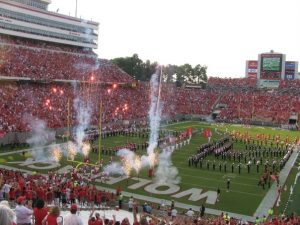 Football has always been an outlet for me. Those four hours allow me to forget about everything else. I may not remember everything about my time in hospitals, but I do remember watching Notre Dame there one day.
I asked the doctor to leave, so I could watch. He said he would leave if I knew what “Notre Dame” meant. I had a trach in my throat and was unable to speak at the time, so I pointed to my mom.
He was impressed that I was a real fan and, honestly, it felt good to show him up as he was a bit of a jerk. I’m not a fan of anyone who tells me I am about to die. Actually, he divorced one of my dearest friends a few years later, so my gut instinct was spot on.
The first investing lesson college football teaches involves abbreviations.
With all of the discussion about the College Football Playoff it’s the perfect time to get a major pet peeve off my chest. The trademarked abbreviation CFP has nothing to do with football! It stands for Certified Financial Planner.
We work hard to get those letters behind our names, so it irks me when writers and announcers use it, and other abbreviations, on television in an effort to sound cool and cling to their lost youth.
Like the stock market, college football has many abbreviations. Some are used for game statistics while others are in the team’s logos. For example, if a USC game is on television, you could be watching Southern California or South Carolina.
Of course, I want you to invest with me, your friendly neighborhood financial planner. However, if you invest on your own, you’ll need to be able identify companies by symbols. One wrong letter can be a completely different company.
Furthermore, we are going to experience abbreviations throughout our investment journey, so we better do our research. Brookstone, the company I use for investment advisory services, is a Registered Investment Advisor (RIA). I am an Investment Advisor Representative (IAR).
We have heard “ICE” all over the news lately giving us another great example. Those three letters can mean frozen water, internal combustion engines in cars, the stock symbol for Intercontinental Exchange Inc., and Immigration and Customs Enforcement. See how confusing that can be?
The second investing lesson college football teaches involves our need for help.
There are 136 college football teams in the FBS (Football Bowl Subdivision…see another abbreviation). The one common denominator among these teams is that they all have coaches. Depending on the size of the budget, there can be a large or a small coaching staff.
The coaching staff works from the sidelines in an effort to maximize the abilities of the athletes on the field. I think financial planners can be viewed as your personal coach. We want you to be placed in a position to succeed.
The athletes need help from each other as well. They may be blessed with all of the talent in the world, but they are useless on the field without their teammates. Nothing would happen if the 11 players did not help each other.
The center gives the ball to the quarterback while the rest of the offensive line blocks the defense. The quarterback then throws the ball to the receivers or hands it to the running back. All together, they execute the coach’s play.
The third investing lesson college football teaches involves diversification.
 Let’s stay on the field and learn about diversification. When a financial advisor talks about building a portfolio, it may help to think about a football team. The portfolio can include a variety of stocks in different sectors, just like a football team needs a variety of players in order to be successful.
When we diversify a portfolio, we are hoping to mitigate the risk that comes with investing. Think of the quarterback as your high risk/high reward stock. The offensive line is like the lower risk/lower return stocks. Together, they provide some protection while the investments in your portfolio work to help you pursue your future goals.
We know that the players on the field must work together. It’s obvious when someone isn’t executing their assignment because the play looks disorganized. When everyone works together, college football is a beautiful thing to watch. Theoretically, that is how a diversified portfolio is supposed to work for you when investing your money.
The yearly controversies surrounding the College Football Playoff allow us to also see the mutual benefit that comes from being in a conference. Again, there are 136 teams and only 12 will have the opportunity to play for a national championship. Of course, there is a big pay day for the program that wins the championship.
However, the other member teams of the victor’s conference will receive some money as well. Basically, teams work with their rivals in order to improve their chances of growth. If hated rivals can put aside their differences because they understand the mutual benefits of diversification, shouldn’t we try to diversify as well?
Finally, the fourth investing lesson college football teaches involves dedication.
One of the hardest things to do when we invest our money is staying dedicated to the long-term plan. In our instant gratification society, we want to enjoy our investment returns as soon as possible. Patience isn’t easy, but the best things in life rarely are.
Navy football shows us what it means to be dedicated to a game plan, especially on the offensive side of the ball. I have seen them take 12 minutes off the clock and score a touchdown on one drive. They frustrate the opponent while maximizing their own strength.
Navy’s system, while not popular or flashy on television, resulted in an 11-2 record this season. No, Navy will not be in the College Football Playoff, but they won the Commander-In-Chief trophy (That is a big deal by the way!). Navy’s success this season gives us a great example for financial planning.
I think we should approach our investments with a similar style, especially when we don’t have much money to invest. Slow and steady can still win the race for us when pursuing our reasonable goals. When our funds are limited, our strategy should focus on the time horizon and consistent contributions.
We all have different goals and may need to take different paths in order to be successful. College football shows us that hard work can still pay off and we should still be encouraged to chase our dreams. Email me!